The Unattended Farm Shop: How Big Does a Rural Diversification Business Need To Be?
From honesty boxes to self-service stores, unattended retail is becoming increasingly common across the rural economy. The more interesting question may not be how these businesses operate, but what actually makes them successful.

For many years, diversification advice frequently followed a predictable logic.
Find a product.
Find a market.
Find more customers.
Then find even more customers.
Growth was generally viewed as both the objective and the measure of success.
Yet across the rural economy, a curious form of diversification is quietly appearing that seems to challenge this assumption entirely.
Roadside honesty boxes.
Self-service farm shops.
Unattended produce sheds.
Card-operated milk dispensers.
Smart vending systems.
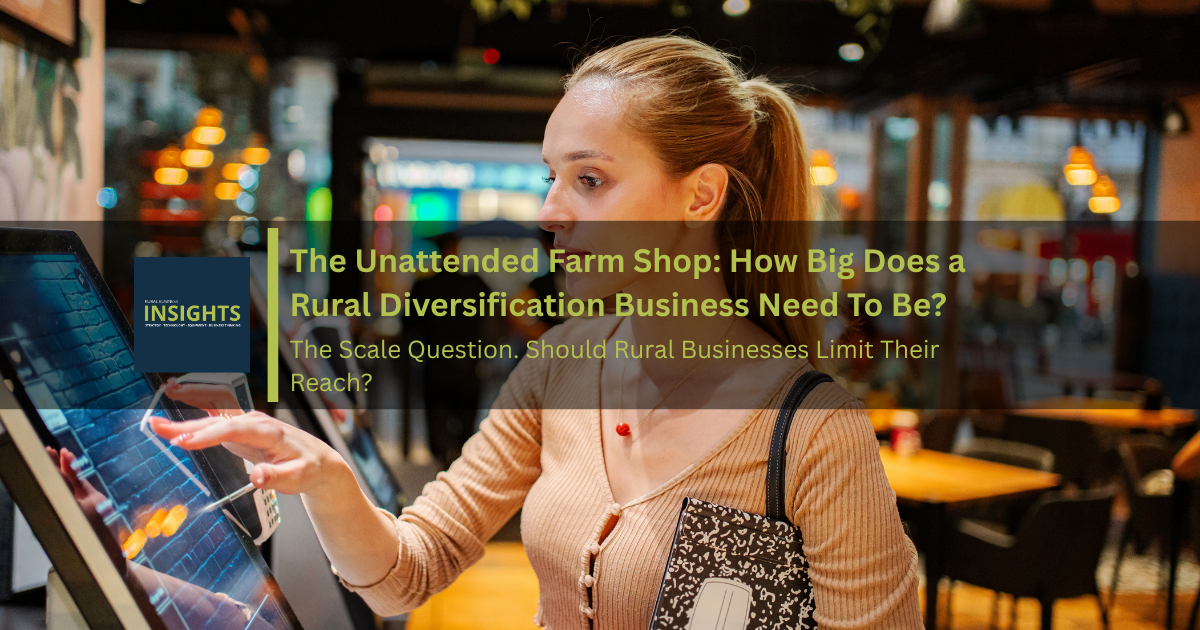
The concept is simple enough. A customer arrives, selects what they want, pays and leaves. Sometimes the transaction relies entirely upon honesty. Increasingly, technology facilitates the process through card terminals, QR codes and digital payment systems. Either way, the business often operates with little or no staff involvement.
What makes these enterprises interesting is not how they work.
It is that they work at all.
The Retail Model That Shouldn't Work
Viewed through a conventional retail lens, the unattended farm shop appears to break several accepted rules.
Traditional retail relies heavily upon management, staffing, supervision and control.
Customers are served.
Stock is monitored.
Transactions are observed.
Security systems attempt to minimise losses.
Yet many farm shops operate on an entirely different foundation.
Trust.
The customer is trusted to pay.
The customer is trusted to behave appropriately.
The customer is trusted to respect the business.
That trust is often rewarded.
Perhaps more consistently than many would expect.
For all the sophistication of modern commerce, there may be a lesson hidden within this simplicity.
Not every successful transaction requires supervision.
Sometimes trust itself creates value.
What Are Customers Actually Buying?
This is where the discussion becomes more interesting.
At first glance the answer appears obvious.
Eggs.
Milk.
Meat.
Potatoes.
Local produce.
Yet if these businesses were simply selling products, many of them would struggle to compete.
Supermarkets generally offer greater choice.
Larger retailers often enjoy purchasing power advantages.
Online retailers can deliver directly to the doorstep.
The product itself rarely explains the whole story.
Instead, many successful farm shops appear to be selling something else.
Convenience.
A drive to the farm gate may take less time than a visit to a town centre.
Parking is easier.
Queues rarely exist.
Access may be available early in the morning, late at night or seven days a week.
The purchase becomes frictionless.
Perhaps the most valuable product in modern rural retail is not the egg, the milk or the potato.
Perhaps it is convenience.
The Scale Question
This naturally leads to a broader business discussion.
How large should a diversification business become?
It is a surprisingly difficult question because growth is often assumed to be inherently positive.
More customers.
More turnover.
More locations.
More products.
More visibility.
Yet the unattended farm shop potentially highlights a limitation within that thinking.
A farm shop serving a highly engaged local community may create substantial value despite relatively modest turnover.
Repeat custom can be remarkably powerful.
The same individuals return weekly.
Relationships develop.
Word-of-mouth recommendations accumulate.
Trust grows.
In contrast, a business chasing ever-expanding catchments may find itself serving more people but building fewer long-term relationships.
The distinction matters.
Growth and value creation are not always synonymous.
A point RBI readers may recognise from our previous discussion of profitability within the dairy sector. Higher output does not automatically produce higher returns.
Should Rural Businesses Limit Their Reach?
This may sound counterintuitive.
Businesses are frequently encouraged to expand their audience.
To increase awareness.
To grow market share.
Yet some rural enterprises appear intentionally focused on serving a relatively small geographical area exceptionally well.
The logic is compelling.
A customer living three miles away may visit every week.
A customer travelling thirty miles may visit once.
The business therefore faces a strategic choice.
Should resources be spent acquiring more distant customers?
Or should they focus on becoming indispensable to nearby customers?
Increasingly, some farm shops seem to be pursuing the latter strategy.
Not because they lack ambition.
Because they understand where their greatest value is created.
Technology Has Changed The Equation
Of course, the modern unattended farm shop is no longer simply an honesty box at the end of a lane.
Technology is beginning to reshape the entire model.
Smart lockers.
Unattended vending systems.
Remote stock monitoring.
Card-only payment systems.
Digital collection points.
Importantly, these innovations do not fundamentally alter the underlying concept.
They simply remove barriers.
Customers who do not carry cash can still purchase.
Businesses can operate longer hours.
Sales become easier to monitor.
Data becomes available.
Technology enhances trust-based retail rather than replacing it.
The principle remains remarkably similar.
Provide useful products.
Make buying easy.
Reduce friction.
What Makes The Model Profitable?
The question inevitably arises.
Can these businesses genuinely make money?
The answer appears to be yes.
But perhaps not for the reasons many assume.
The most successful examples often benefit from:
- Existing buildings.
- Existing land.
- Existing production.
- Minimal staffing requirements.
- Relatively low operating costs.
In many cases, the diversification does not need to support an entirely separate business.
It only needs to create additional value from assets that already exist.
That distinction is important.
A farm shop generating a modest but reliable contribution to profitability may be significantly more valuable than a larger diversification requiring substantial infrastructure, staffing and management.
The strongest businesses are not always those generating the highest revenue.
They are often those producing the strongest return relative to complexity.
The RBI Reflection
The unattended farm shop may ultimately represent a challenge to several modern business assumptions.
Retail does not always require staff.
Technology does not always replace trust.
Growth does not always require scale.
Success does not always depend on becoming larger.
Perhaps most importantly, these businesses remind us that value is often created by solving very simple problems well.
The customer wants fresh produce.
The customer wants convenience.
The customer wants trust.
The customer wants simplicity.
Businesses that deliver those things consistently often find that scale becomes a secondary consideration.
The more interesting question therefore may not be:
"How large can an unattended farm shop become?"
Instead, it may be:
"How much value can it create before becoming something entirely different?"
And for many rural businesses considering diversification, that may be the more useful question to ask.
Sources
Discussion informed by current developments in farm-gate selling, self-service retail, smart lockers and unattended farm-shop models.