The Next Resource Battle Is Water
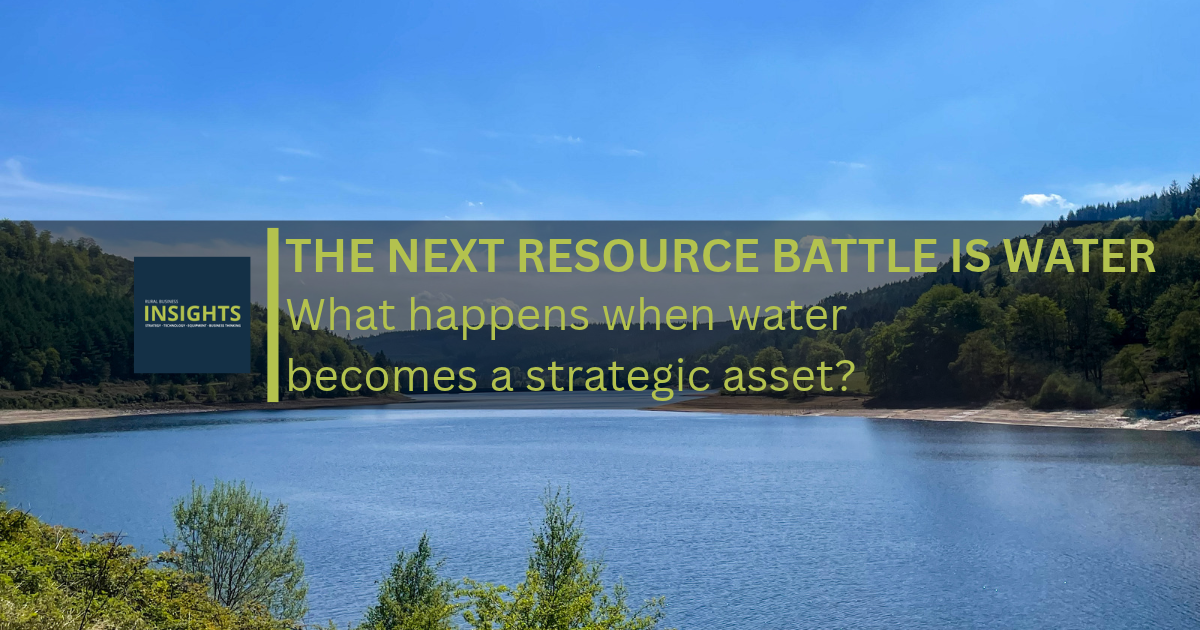
Drought concerns and shrinking reservoir levels are forcing difficult decisions for growers. But this is about more than potatoes and vegetables. Water is increasingly becoming a strategic business asset, with implications for food security, resilience and future agricultural competitiveness.

Drought, food security and why water may be becoming agriculture's most important strategic asset
Recent headlines have focused on concerns that drought conditions could reduce supplies of potatoes, onions and carrots, potentially contributing to higher food prices in the years ahead. Behind those warnings sits a much larger question. This is not simply a story about vegetables. It is a story about resources, risk and the future economics of food production. Recent reports suggest growers are already reassessing planting decisions because of uncertainty around irrigation water and reservoir levels.
For generations, agricultural discussions have revolved around land.
How much land is available?
What can it produce?
How should it be managed?
Land remains fundamental, but another resource is quietly becoming more influential. Increasingly, the question is no longer simply what a business can grow. The question is what a business can reliably support with the water available to it.
In many parts of British agriculture, water is beginning to look less like an input and more like a strategic asset.
The Drought Behind The Headlines
The recent concern around vegetable crops did not emerge in isolation.
The Environment Agency has warned that reservoir levels remain significantly below seasonal norms, with national reservoir storage reported at around 54 per cent of capacity. Particular concern has centred on the ability of agricultural water-storage reservoirs to refill adequately ahead of the 2027 irrigation season. [gov.uk]
That creates a difficult challenge for growers.
Agriculture has always operated with uncertainty. Weather, markets, labour availability and policy changes all influence decision-making. Water scarcity adds another layer of uncertainty.
A grower making cropping decisions today may be asking:
- Will sufficient irrigation water be available?
- Will reservoirs refill adequately?
- Is a high-value crop still worth the risk?
- Should acreage be reduced?
- Should different crops be considered?
These questions influence supply long before consumers notice anything on supermarket shelves.
When food prices eventually rise, the underlying decisions may have been taken months or even years earlier.
When Water Becomes Capital
Historically, agricultural capital investment often focused on:
- land acquisition;
- buildings;
- machinery;
- livestock;
- storage infrastructure.
Increasingly, water infrastructure joins that list.
Reservoir construction, pumps, irrigation systems, pipe networks and water-storage capacity all require substantial investment. They generate little excitement compared with a new tractor or a new building project, yet they may prove equally important.
This represents an important shift in thinking.
Traditionally, water was often treated as an operational requirement.
Now it increasingly resembles a productive asset.
A business with secure access to water may possess a significant competitive advantage over one that relies heavily on uncertain seasonal supplies.
That advantage is not always obvious during a normal year.
It becomes very obvious during a dry one.
The Myth of the "Thirsty Crop"
Public discussion often focuses on whether particular crops are water intensive.
Potatoes regularly attract attention because they require irrigation in many growing regions and are vulnerable to drought stress. Yet this discussion can be surprisingly misleading.
Research commonly places potato water footprints somewhere in the region of 200-300 litres per kilogram, while some studies report lower figures depending upon methodology and location. Potatoes are frequently cited as one of the more water-efficient staple foods when measured against food output.
That is not the same as saying potatoes require little water.
They clearly do.
The more interesting question is:
Should resource allocation be judged by water consumption alone, or by the food produced from that water?
A crop's value is not simply measured by how much water it consumes. It can also be measured by:
- food output;
- nutritional contribution;
- economic return;
- employment generated;
- resilience provided within domestic supply chains.
This changes the conversation considerably.
The challenge may not be that potatoes use water.
The challenge may be ensuring enough water exists to support the domestic production of crops that society wants and needs.
From Production Decisions to Risk Decisions
One of the most important consequences of water uncertainty is that agricultural decisions become risk-management decisions.
Traditionally, a grower might ask:
What should I plant?
Increasingly the question becomes:
What level of water-related risk am I prepared to accept?
That distinction matters.
In recent years farm businesses have become increasingly accustomed to managing:
- weather risk;
- labour risk;
- market risk;
- policy risk;
- energy risk.
Water risk is joining that list.
And because irrigation infrastructure is costly, the ability to manage that risk may become unevenly distributed.
Businesses with storage, infrastructure and capital may enjoy options unavailable elsewhere.
Those without may find themselves increasingly constrained.
The Hidden Cost of Food Security
Earlier this year, we explored the question:
Food Security Has a Price. Are We Prepared to Pay It?
Water reinforces that argument rather than replacing it.
A resilient domestic food system requires more than willing farmers.
It requires infrastructure.
Storage.
Processing.
Distribution.
And increasingly, water security.
If British society wishes to maintain domestic production in the face of more frequent drought conditions, investment will be required somewhere within the system.
The obvious question is:
Who pays?
Possible answers include:
- individual farm businesses;
- water companies;
- government;
- food processors;
- retailers;
- consumers.
There is no simple solution.
But avoiding the question does not make the cost disappear.
It merely shifts it elsewhere.
Eventually it appears as:
- higher food prices;
- reduced domestic production;
- greater import dependence;
- increased business vulnerability.
Diversification Changes The Equation
This discussion also interacts with a theme increasingly visible across the rural economy: diversification.
Businesses such as food processors, farm retailers and direct-to-consumer enterprises often generate income streams that are less directly dependent upon individual crop yields.
That does not eliminate water risk.
It does, however, alter how that risk is distributed throughout the business.
A diversified enterprise may possess greater flexibility in responding to difficult production conditions than a business entirely dependent on agricultural output alone.
This may become an increasingly important consideration as climate variability and resource pressures increase.
The objective is not to abandon production.
The objective is to build resilience around it.
The Next Resource Battle
Agricultural history is, in many ways, a history of resource management.
Land.
Labour.
Fuel.
Machinery.
Technology.
Each has acted as a limiting factor at different moments.
Land will remain important.
But if current trends continue, water may increasingly become the resource around which future business decisions are organised.
That does not mean the future is one of inevitable shortage.
It does mean that businesses, policymakers and supply chains may need to think differently about investment and resilience.
The headline may be about potatoes.
The strategic issue is much larger.
Because this is not really a story about vegetables.
It is a story about the resource that makes agriculture possible in the first place.
And the businesses that understand that shift early may find themselves holding one of the most valuable strategic assets on the farm.
References
- The Times, Food price rises loom as drought-hit farmers cut back on thirsty vegetables, October 2026. [tuttiquotidiani.it], [linkedin.com]
- Environment Agency drought and reservoir reporting, October 2026. Reservoir levels reported at approximately 54% of capacity nationally, with concerns regarding agricultural reservoir replenishment. [gov.uk]
- Various potato water-footprint studies and summaries, indicating approximate water-use estimates commonly reported in the region of 200–300 litres per kilogram depending on methodology and location. [potatopedia.com], [farmonaut.com], [freshplaza.com]