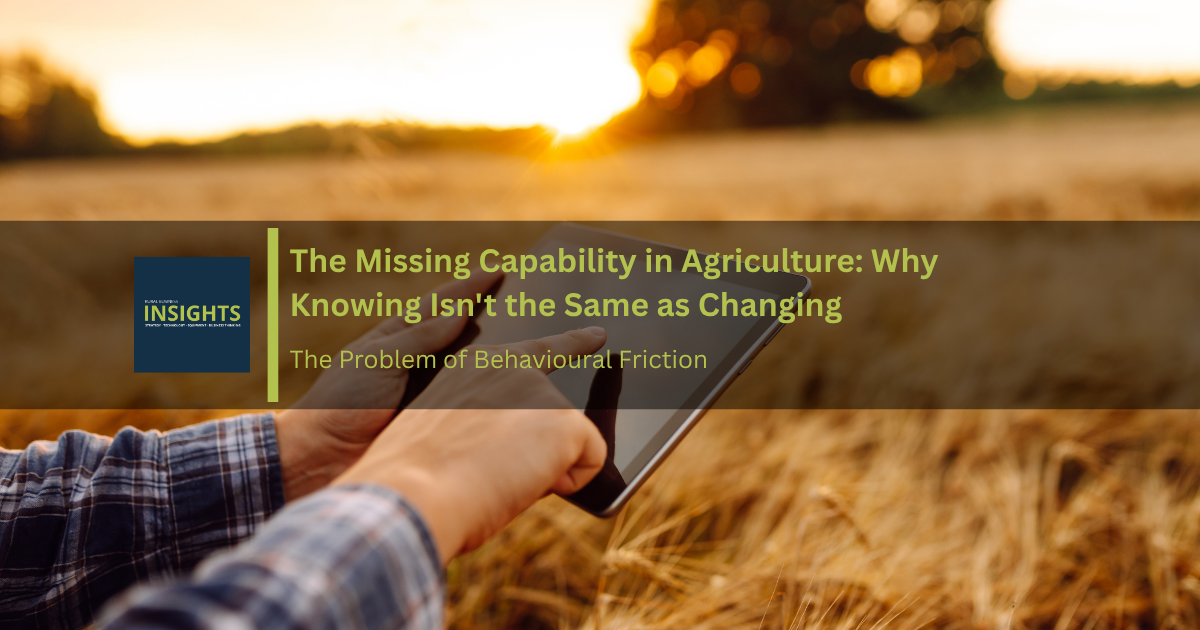
The Missing Capability in Agriculture: Why Knowing Isn't the Same as Changing
A recent Nuffield Farming Scholarship argues that agriculture's primary challenge is not a lack of knowledge, but a lack of behavioural change. The strongest businesses are often those that build the habit of adaptation.

For decades, improving agricultural performance has often been framed as a knowledge problem.
If farmers receive better advice, better information, better technology or better data, business performance should improve.
It sounds logical.
Yet a recent Nuffield Farming Scholarship examining behavioural change in UK agriculture suggests the industry's primary challenge may not be a lack of information at all.
Instead, it may be a lack of change.
The distinction matters.
Because if the problem is not knowledge, then providing more of it may not produce the results policymakers, advisers and businesses hope for.
Agriculture Already Knows A Great Deal
One of the report's most striking conclusions is that UK agriculture does not necessarily suffer from a shortage of technical knowledge.
Good animal husbandry is understood.
Good grazing management is understood.
Good financial management is understood.
Good soil management is understood.
Many of the technical solutions required to improve performance already exist. The challenge is that understanding something and implementing it are not always the same thing.
This is hardly unique to agriculture.
Most people understand the benefits of exercise.
Few maintain perfect fitness.
Most businesses understand the importance of planning.
Not all make time for it.
Knowledge alone rarely guarantees action.
The Problem of Behavioural Friction
The report introduces a concept described as behavioural friction.
In simple terms, behavioural friction emerges when:
- what a business does,
- what its owners believe,
- and where it wants to go,
are no longer properly aligned.
The result is often hesitation.
Sometimes opportunities are recognised but not pursued.
Sometimes change is discussed but not implemented.
Sometimes businesses acknowledge challenges but continue to operate exactly as they always have.
The issue is not necessarily capability.
It is movement.
A business may understand where it wants to be whilst struggling to take the steps necessary to get there.
Change Is Often Cultural, Not Technical
Agriculture is full of innovation.
New genetics.
New machinery.
New software.
New environmental schemes.
New business models.
The report argues that the greatest challenge is rarely the availability of these opportunities.
Instead, the challenge often lies in the culture surrounding them.
Agriculture remains deeply connected to:
- identity,
- family history,
- succession,
- tradition,
- place.
These characteristics are frequently strengths.
They create resilience, continuity and long-term thinking.
Yet they can also make change difficult.
When business decisions become closely connected to personal identity, adaptation can feel far more significant than simply adopting a new practice.
It can feel like questioning who we are.
The Strongest Businesses Build The Habit Of Change
One of the most encouraging findings from the study is that adaptability appears less dependent on resources than many people assume.
The businesses most capable of responding to change were not always:
- the largest,
- the wealthiest,
- the best resourced,
- or operating on the most productive land.
Instead, they had developed something else.
They had built the habit of adaptation.
Across six countries and more than sixty businesses, a common pattern emerged. The strongest organisations treated change as a repeatable process rather than a crisis response.
They:
- tested ideas on a small scale,
- learned from mistakes,
- recorded outcomes,
- refined systems,
- and adjusted course where necessary.
Change was not viewed as a one-off event.
It was part of how the business operated.
Alignment Matters More Than People Realise
Another observation from the report feels particularly relevant.
The businesses performing best were not necessarily those with the strongest marketing, the largest scale or the most sophisticated technology.
They were often the businesses where:
- identity,
- systems,
- direction,
- and market position
were pointing in the same direction.
That alignment created momentum.
Employees understood priorities.
Investment decisions made sense.
Opportunities could be assessed against a clear purpose.
Without alignment, even well-resourced businesses often struggled.
The lesson extends beyond agriculture.
A business does not need perfect information to move forward.
It often needs clarity about where it is trying to go.
What Does This Mean For Rural Businesses?
Much of the modern rural economy is characterised by constant change.
Policy evolves.
Markets fluctuate.
Technology develops.
Environmental expectations increase.
Consumer preferences shift.
The response is often to focus on acquiring more information.
Yet this study suggests a different question may deserve attention first.
How capable is the business of changing at all?
Because even the most accurate information creates little value if an organisation lacks the ability to act upon it.
In that sense, adaptability becomes a business capability in its own right.
Just as important as:
- technical skill,
- financial management,
- marketing,
- or operational efficiency.
Perhaps even more so.
The RBI Reflection
One theme appears repeatedly throughout Rural Business Insights.
The strongest businesses rarely succeed because they possess perfect knowledge.
They succeed because they remain capable of adapting when circumstances change.
The modern rural economy offers no shortage of information.
Advice is abundant.
Data is abundant.
Reports are abundant.
Yet change remains difficult.
That is what makes this research so valuable.
It shifts the conversation away from:
"What do businesses need to know?"
and towards:
"What helps businesses actually change?"
The answer appears to have less to do with information and more to do with behaviour.
Less to do with knowledge and more to do with action.
Perhaps the most hopeful conclusion of all is the one highlighted by the author himself:
The capacity to change is not fixed. It can be built.
Acknowledgement
This article draws upon findings from Peter Green's Nuffield Farming Scholarship report, Unlocking Behavioural Change in UK Agriculture: Why UK Farm Businesses Struggle to Change, and What to Do About It.