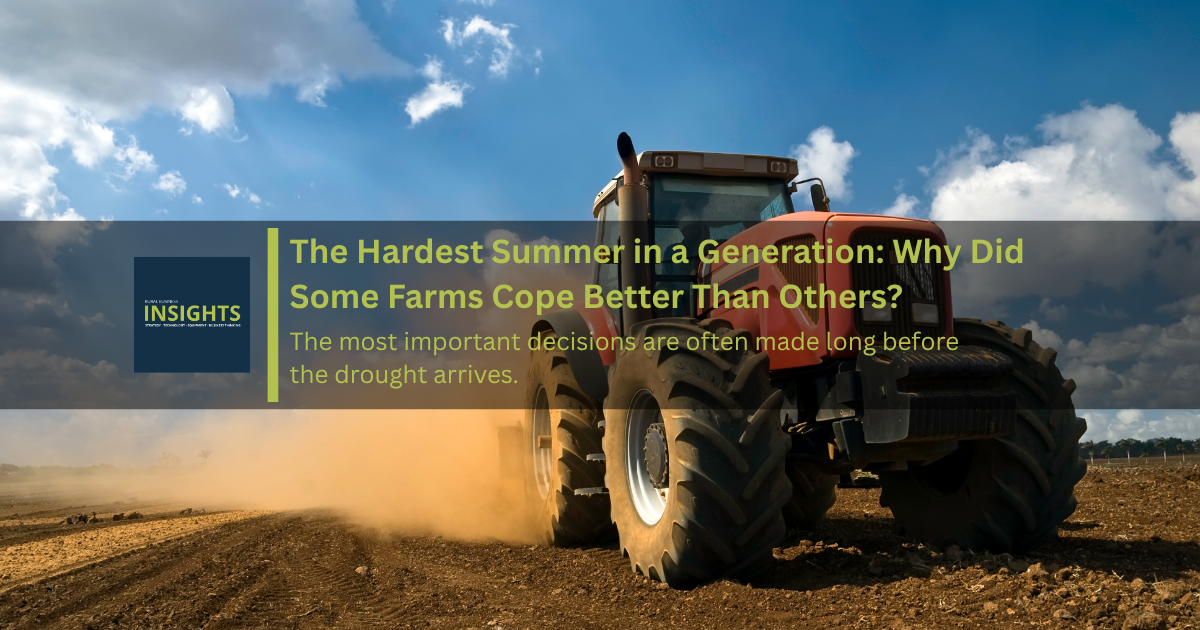
The Hardest Summer in a Generation: Why Did Some Farms Cope Better Than Others?
Derbyshire farmers have described 2026 as the hardest summer in a generation. Yet harvest evidence suggests some businesses performed far better than others. The weather was the same. The outcomes were not.

During early October, farmers across Derbyshire described 2026 as the hardest summer in a generation. Reports of failed crops, burned-off grassland, rising input costs and mounting financial pressure dominated local headlines. Amy Wheelton, farming in South Derbyshire, described winter beans dying during the first heatwave, whilst High Peak dairy farmer David Handford warned that confidence was fragile and cashflow had reached crisis point for many businesses.
The headlines are dramatic.
The circumstances are real.
Yet one observation within the accompanying harvest assessments may be even more important than the drought itself.
The weather was largely the same.
The outcomes were not.
A Difficult Year By Any Measure
Few would dispute that 2026 has been an exceptionally challenging season.
Spring was reported as the warmest on record across England and Wales, whilst rainfall levels fell significantly below long-term averages. Across much of the East Midlands, drought conditions created pressure on grass growth, forage supplies and crop yields.
The economic consequences quickly followed.
Lower yields.
Reduced feed availability.
Additional cost pressures.
Greater uncertainty.
For some businesses, the impact was severe.
The temptation is therefore to describe the year as simply a weather story.
Yet weather alone does not fully explain what happened.
The Most Interesting Finding
The Agriculture and Horticulture Development Board (AHDB) harvest assessment highlighted that yields across the region were "highly variable". Some farms suffered substantial reductions, whilst others achieved results close to, or even exceeding, their long-term averages.
That finding changes the discussion completely.
If everyone had experienced similar outcomes, the explanation would be straightforward.
Bad weather created bad results.
Instead, the evidence suggests that some businesses demonstrated greater resilience than others despite operating through broadly the same climatic conditions.
That raises a far more interesting business question:
What creates resilience before a difficult year arrives?
Derbyshire Is Not One Farming System
This question is particularly relevant in Derbyshire.
The county contains a remarkable variety of farming environments.
Heavy clay land in some areas.
Freer-draining soils in others.
Limestone uplands.
Improved grassland.
Mixed livestock systems.
Arable enterprises.
Dairy businesses.
Each responds differently to weather stress.
So whilst it may be tempting to view "Derbyshire agriculture" as a single entity, the reality is more complicated.
The same rainfall deficit can produce very different consequences depending upon:
- Soil structure.
- Organic matter levels.
- Water-holding capacity.
- Cropping systems.
- Grazing management.
- Previous investment decisions.
This is where weather becomes less important than management.
Resilience Is Rarely Built During A Crisis
The AHDB observations are revealing because many of the factors influencing outcomes were already established before the drought arrived. The organisation highlighted variables such as soil type, moisture retention, drilling date, previous cropping history and the use of organic fertilisers as contributing factors.
None of those decisions were made during the heatwave.
Most were made months or years earlier.
That suggests resilience operates much like financial strength.
It is rarely created at the moment it becomes necessary.
It is built beforehand.
A drought cannot suddenly create soil organic matter.
A forage shortage cannot suddenly improve grazing infrastructure.
A difficult season cannot instantly establish stronger cash reserves.
The foundations already exist long before the pressure arrives.
The Financial Question
The comments surrounding confidence and cashflow may be equally important.
When businesses experience difficult seasons, the consequences extend beyond agricultural performance.
Investment decisions are postponed.
Expansion plans are reconsidered.
Maintenance gets delayed.
Risk tolerance declines.
The impact often continues long after rainfall returns.
This creates another layer of resilience that receives less attention.
Financial resilience.
Two farms can experience identical weather conditions and achieve broadly similar yields.
Yet if one possesses stronger cash reserves, lower borrowing levels or greater diversification, its ability to absorb disruption may be entirely different.
The weather creates pressure.
Financial structure determines how well a business tolerates it.
What Other RBI Themes Tell Us
This discussion feels familiar because it echoes several wider conversations occurring throughout the rural economy.
The article on behavioural change explored how the strongest businesses often build the habit of adaptation before change becomes unavoidable.
The upland sheep farming discussion highlighted the importance of balancing multiple objectives rather than maximising a single output.
Even the recent consideration of unattended farm shops centred on how apparently simple systems often create resilience through practicality and repeatability.
The common thread is consistent.
Resilience rarely arrives suddenly.
It accumulates over time through countless decisions.
Some visible.
Some not.
The RBI Reflection
It is easy to remember 2026 as the year of drought.
It may prove more useful to remember it as the year resilience became visible.
Good weather can disguise weaknesses.
Difficult weather rarely does.
The most striking lesson from the East Midlands harvest may not be that conditions were challenging.
It may be that businesses exposed to the same summer produced very different results.
The weather was the same.
The outcomes were not.
Perhaps that tells us something important.
Resilience is not built during difficult years.
Resilience is revealed by them.
References
Winter, J. and Carr, B., Farmers suffer 'hardest summer in generations', BBC News, 4 October 2026.
Agriculture and Horticulture Development Board (AHDB), Harvest 2026 Commentary and Yield Assessment, referenced in BBC News reporting, October 2026.