Progressive Poultry: Can Efficiency, Welfare and Sustainability Coexist?
Modern poultry production has become remarkably efficient, but efficiency is no longer the only measure of success. Welfare, sustainability and profitability increasingly compete for attention, creating a new challenge for progressive poultry businesses.

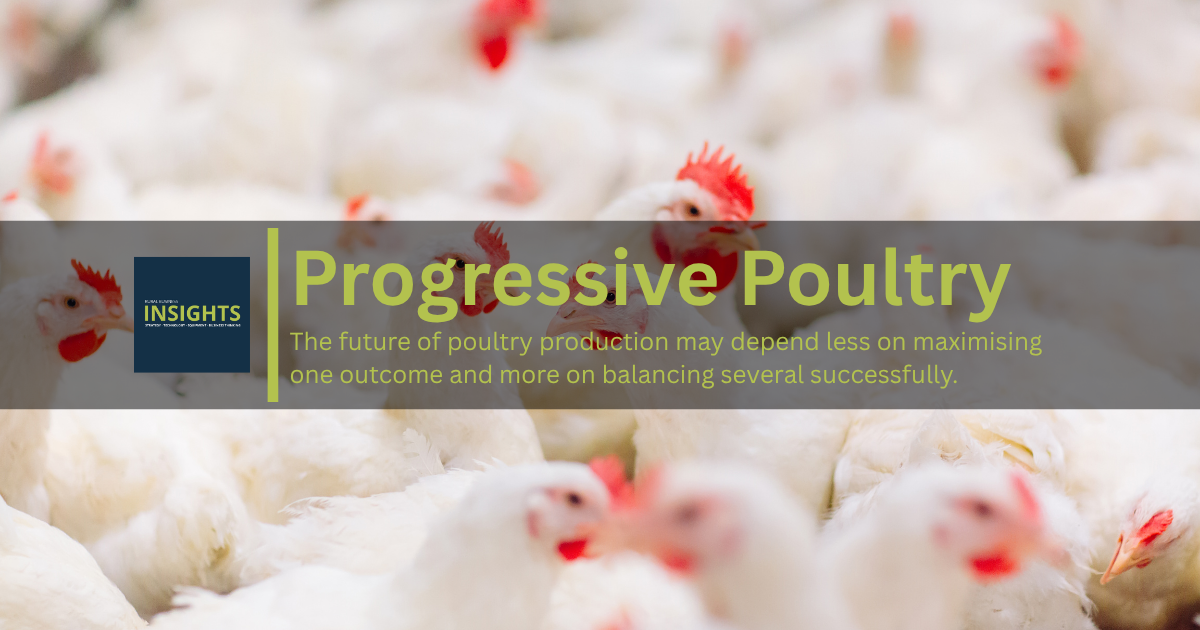
Chicken has quietly become one of the great success stories of modern food production.
Affordable, versatile and widely accepted across cultures, poultry now occupies a central position within global diets. In the UK, chicken has become the country's most consumed meat protein, with demand continuing to grow as consumers seek relatively affordable sources of animal protein. Globally chicken consumption is expected to continue increasing, with poultry projected to account for an ever-greater share of meat protein consumption.
Behind that success sits a remarkable story of technical progress.
Modern broiler chickens routinely reach market weight of approximately 2.3kg within around five weeks whilst achieving feed conversion ratios that would have been almost unimaginable a few decades ago. Researchers estimate broiler growth rates have increased by approximately 400% over the past sixty years through advances in breeding, nutrition, management and housing systems.
For consumers, this has delivered affordable food.
For producers, it has created one of the most efficient animal-protein systems in agriculture.
Yet success has a habit of creating its own challenges.
When One Success Metric Is No Longer Enough
Historically, agricultural systems were often judged against a relatively straightforward objective.
Produce more.
Produce efficiently.
Remain profitable.
Increasingly, however, poultry producers face scrutiny from several directions simultaneously.
Consumers want affordable food.
Retailers want reliable supply.
Governments want reduced environmental impacts.
Society expects high animal-welfare standards.
Businesses still need to remain profitable.
The result is an industry attempting to optimise several objectives at the same time.
And that, as many rural businesses will recognise, is considerably more difficult than optimising only one.
The Welfare Challenge
One of the most discussed consequences of modern broiler efficiency is leg health.
The scientific literature highlights a mismatch between rapid muscle development and skeletal maturity within modern broilers. Birds may reach commercial slaughter weight at around five weeks of age, whilst skeletal development continues much longer. Researchers have linked this imbalance to mobility challenges and leg disorders that can affect bird welfare.
The figures are striking.
A UK survey of commercial broiler flocks found poor mobility in more than 27% of birds approaching slaughter age, whilst approximately 3.3% were almost unable to walk. More recent Norwegian research identified around 25% of broilers showing moderate to severe mobility defects.
Importantly, this is not necessarily an indictment of producers.
Rather, it demonstrates a familiar reality.
When one objective is pushed successfully, other constraints tend to emerge.
The poultry sector's productivity gains have therefore intensified discussions around welfare and management practices.
The Soy Question
Welfare is not the only challenge attracting attention.
Feed remains one of the largest cost and sustainability considerations within poultry production.
Soybean meal continues to be widely used as a high-protein feed ingredient. However, concerns around imported protein, land use, supply-chain resilience and environmental impact have encouraged researchers to explore alternatives.
What makes this discussion interesting is that assumptions about sustainability do not always survive contact with evidence.
The study reviewed more than 100 broiler feeding experiments before modelling the environmental impact of several alternative ingredients within UK production systems.
The findings challenge some commonly held beliefs.
Sustainability Isn't Always What It Appears
Processed animal proteins, including meat and bone meal, produced some of the strongest overall outcomes within the environmental modelling.
At inclusion rates of 10-15%, researchers reported reductions in greenhouse gas emissions, land use and water consumption associated with chicken production.
By contrast, microalgae, often promoted as an innovative future protein source, increased modelled greenhouse gas emissions and water consumption within the scenarios studied. Researchers linked this in part to the energy and resources required for cultivation, harvesting and processing.
This does not mean microalgae lacks potential.
It means sustainability is rarely as simple as good intentions.
The most sustainable solution is not always the one that sounds most sustainable.
That lesson extends well beyond poultry production.
Progressive Poultry
The phrase "progressive poultry" often brings technology to mind.
Automation.
Data.
Genetics.
Feed innovation.
In reality, progression may increasingly be defined by something else.
Balance.
The modern poultry business is no longer judged solely on output.
It is increasingly being assessed across:
- Productivity
- Animal welfare
- Sustainability
- Resource efficiency
- Profitability
Maximising all five simultaneously may prove impossible.
Managing the trade-offs intelligently may become the defining challenge.
Lessons For The Wider Rural Economy
This is where the poultry story becomes relevant to readers far beyond the poultry sector.
Many rural businesses face remarkably similar pressures.
Arable enterprises balance productivity and environmental delivery.
Livestock farms balance efficiency and welfare.
Diversified businesses balance profitability and customer experience.
Everywhere, multiple objectives compete for attention.
The poultry industry may simply be confronting first what many sectors will eventually experience.
Success becomes more difficult to define.
Because one measure is no longer enough.
The RBI Reflection
Viewed through a business lens, progressive poultry is not really a poultry story.
It is a story about optimisation.
The easiest target is often a single metric.
Output.
Yield.
Growth.
Performance.
Yet modern businesses increasingly discover that success is determined by several outcomes simultaneously.
The poultry sector's extraordinary gains in efficiency are undeniable.
What is equally interesting is what has happened next.
The conversation has widened.
Welfare matters.
Sustainability matters.
Resilience matters.
Profitability still matters.
The future may not belong to businesses that maximise one objective most effectively.
It may belong to those capable of balancing several successfully.
And that is a lesson that extends well beyond chickens.
References (Oxford Style)
Muir, W.I., Groves, P.J. and Reece, R.L., Managing Health Issues in Broilers: Leg Health and Leg Problems, Burleigh Dodds Science Publishing, 2026.
Stocks, C., Animal by-products show promise as an alternative to soy in broiler feed, Farming Future Food, 2026.