Diversification Isn't About Having Ideas: It's About Knowing Which Idea Deserves Your Money
Rural businesses rarely suffer from a shortage of diversification ideas. The harder question is deciding which opportunity genuinely deserves the capital, management time and risk required to make it work.

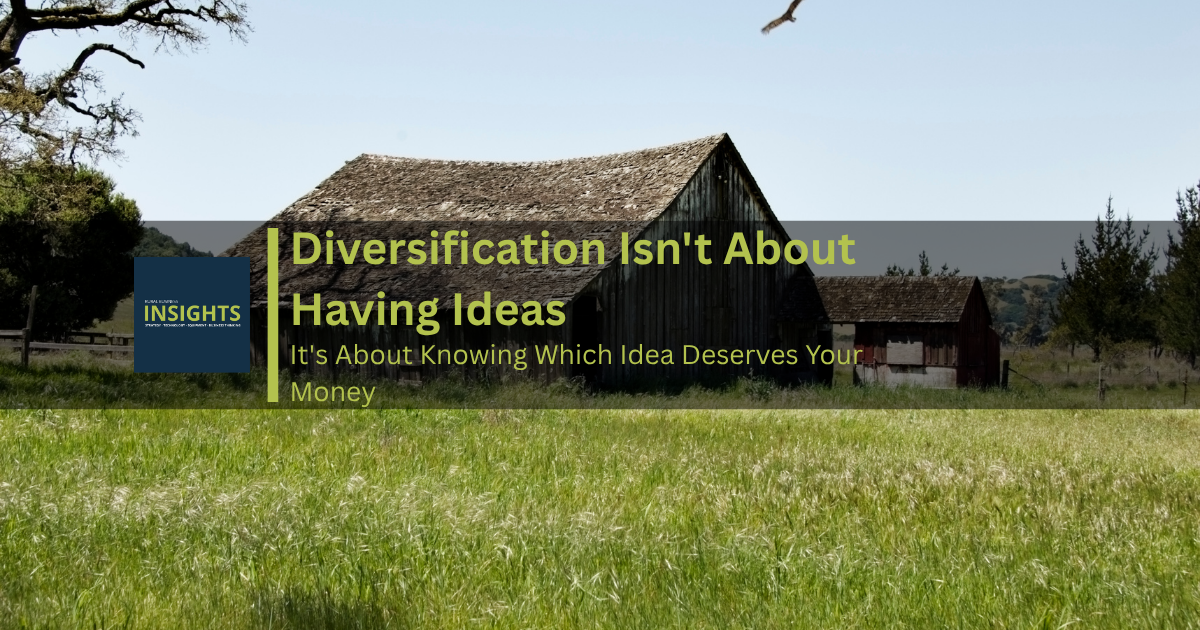
Most rural businesses do not suffer from a shortage of diversification ideas.
There is nearly always a building that could be converted, a corner of the yard doing very little, a roof capable of generating electricity, or a field that might earn more from something other than conventional agricultural production.
Dog exercise fields.
Storage units.
Camping.
Glamping.
Offices.
Renewable energy.
Visitor attractions.
The list can become surprisingly long.
The difficult question is rarely:
What could we do?
It is:
What should we do?
That distinction matters, because an opportunity is not automatically a good investment simply because somebody else has made it work.
The Numbers Can Be Seductive
Recent analysis from Ceres Rural provides a useful illustration of just how varied diversification opportunities can be.
At the relatively accessible end, the analysis suggests a secure dog-walking field might require around £8,000–£10,000 of setup expenditure. Using assumptions of £12 per session and 80% occupancy, the example suggests revenue approaching £3,500 per month and potentially a very short payback period.
Container storage presents another comparatively straightforward proposition. The analysis gives indicative container costs of £2,500–£4,000 each, with rental income of around £120–£200 per month plus VAT, producing a theoretical payback period of one to two years.
At the other end of the scale, two padel courts and an associated barn conversion are estimated from around £200,000, while a farm-scale solar and battery installation is modelled at approximately £80,000–£100,000.
These figures are useful.
They are also potentially dangerous if treated as answers rather than starting points.
Because the most attractive payback period on paper may belong to an enterprise completely unsuited to the business considering it.
Payback Isn't The Same As Suitability
A dog exercise field may appear extraordinarily compelling if the investment is modest and demand exists.
But where is the farm?
How many people live nearby?
How easily can customers access the site?
What alternatives already exist?
Will neighbours object to additional traffic?
Who maintains the field?
What happens to bookings through a wet Derbyshire winter?
Suddenly, the calculation is about considerably more than fencing and a booking website.
The Ceres Rural analysis itself acknowledges the importance of location, accessibility, nearby population, management requirements, business rates, planning and existing agreements.
That is where diversification stops being an ideas exercise and becomes strategic planning.
The Cheapest Opportunity Could Be The Wrong One
There is a natural attraction towards opportunities with comparatively low capital requirements.
That is understandable.
Lower investment generally means less capital at risk.
It makes experimentation easier.
It can also potentially allow a business to prove demand before committing further money.
But low cost does not guarantee strategic fit.
A business might have exactly the right land for a dog field yet have no interest in dealing with consumer bookings.
A beautiful site might appear ideal for camping until somebody realises that the business does not want dozens of people arriving every weekend.
A redundant building may look perfect for offices, but only if businesses actually want to rent offices in that location.
The central question is therefore not:
How quickly will it pay back?
It is:
Why should customers buy this from us?
Without a convincing answer, even a cheap diversification can become expensive.
Management Time Is Capital Too
This is one of the easiest costs to underestimate.
Certain diversification projects primarily require money.
Others require the business owner.
Camping and glamping, for example, may require relatively active management when guests are present. The source specifically cautions that some diversification options need somebody on site daily, while others require substantially less ongoing management once established.
That distinction matters enormously.
A diversification may generate additional turnover while quietly consuming the time previously available to manage the core farming business.
Suddenly the relevant calculation is not simply:
Revenue minus direct costs.
It must also consider:
- management time;
- staffing;
- administration;
- maintenance;
- customer service;
- marketing;
- disruption to existing operations.
There is little value in creating a profitable diversification if it simultaneously makes the rest of the business worse.
Existing Assets Often Deserve First Attention
One of the more interesting themes appearing repeatedly through Rural Business Insights is the value of asking existing assets to perform more than one job.
We recently explored this through farm reservoirs, where an asset traditionally associated with water storage can potentially contribute to irrigation resilience, renewable generation and wider infrastructure value.
Diversification can work in much the same way.
A redundant building already exists.
A roof already exists.
A secure yard already exists.
A field already exists.
Using an existing asset in a more productive way can fundamentally change the economics of a project because some of the underlying investment has already been made.
The opportunity is therefore not always:
What else can we build?
Sometimes it is:
What else can what we already own do?
Bigger Investments Need Better Questions
Larger opportunities inevitably raise the stakes.
The source gives an indicative investment of around £200,000 for two padel courts and associated conversion, with possible payback in the region of three to five years under its assumptions. It also warns of planning risk, local competition and management requirements.
At that point, enthusiasm really isn't enough.
The questions become more demanding.
How much of the capital is borrowed?
What happens if utilisation is 40% instead of 75%?
What happens if a competitor opens nearby?
What is the residual value of the investment?
Could that £200,000 produce a better return somewhere else in the business?
And perhaps most importantly:
What happens if the idea works, but not quite as well as the spreadsheet predicted?
Businesses rarely fail because their spreadsheet contained no return.
The more difficult scenarios are often those where the return exists, but is insufficient to compensate for the capital, risk and management absorbed.
Diversification Should Strengthen The Business
This may be the most useful test of all.
Diversification exists, fundamentally, to make the wider business stronger.
That can happen in several ways.
It might:
- create another income stream;
- make better use of existing assets;
- reduce exposure to commodity markets;
- spread seasonal cashflow;
- introduce direct customer relationships;
- improve the utilisation of buildings, land or infrastructure.
But merely adding another activity does not automatically make a business more resilient.
Sometimes it simply makes it more complicated.
Successful diversification should therefore have a clear role.
What problem is it solving?
What asset is it improving?
What risk is it reducing?
What market is it accessing?
What return is expected?
And what does the business have to give up to make it happen?
Start With The Business, Not The Idea
Perhaps the biggest danger in diversification is beginning with an attractive opportunity and working backwards.
"We could build a glamping site."
"That barn would make good offices."
"Everyone seems to be playing padel."
The better process starts somewhere else.
What assets does the business possess?
Where are those assets located?
What does the local market need?
What skills already exist within the business?
How much capital can realistically be committed?
How much additional management can the business tolerate?
What return does the investment actually need to generate?
Only then should the idea enter the conversation.
The RBI Reflection
Diversification is often presented as an exercise in imagination.
In reality, it may be an exercise in restraint.
Rural Britain is full of assets capable of doing more.
Buildings.
Land.
Roofs.
Yards.
Locations.
Knowledge.
Experiences.
The challenge is not finding something that could be done with them.
The challenge is identifying the opportunity where market demand, location, capital, management capability and strategic purpose genuinely align.
A quick payback is attractive.
A fashionable idea is exciting.
A new income stream is reassuring.
But none of those characteristics automatically makes something a good business decision.
Perhaps the question rural businesses should ask is not:
What could this land earn?
But:
Which opportunity deserves our money, our time and our attention?
Because diversification succeeds not when a business has the most ideas.
It succeeds when it chooses the right one.
Acknowledgement
This article was developed following analysis published by Ceres Rural examining indicative investment, returns and payback periods across a range of common farm diversification opportunities. The figures cited are illustrative and will vary materially between individual sites and businesses.
Reference
Atkinson, A., Farm Diversification: What Could Your Land Earn, and How Quickly?, Ceres Rural, 14 October 2026.