Building The Infrastructure Before The Industry Exists
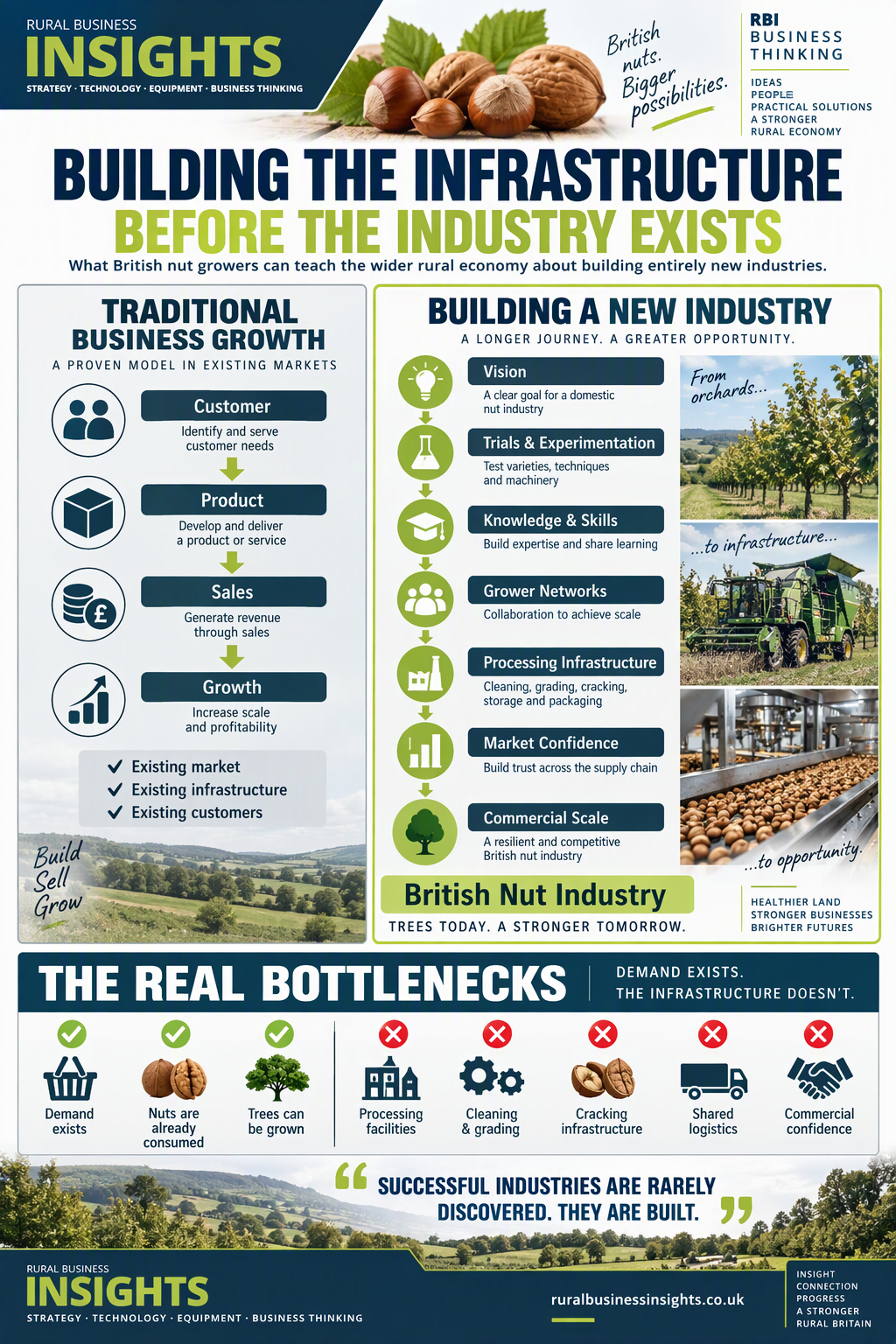
Britain imports almost all the nuts it consumes. New orchards are being planted, machinery trials are underway and grower networks are forming. The challenge may not be growing nuts. It may be building everything else.

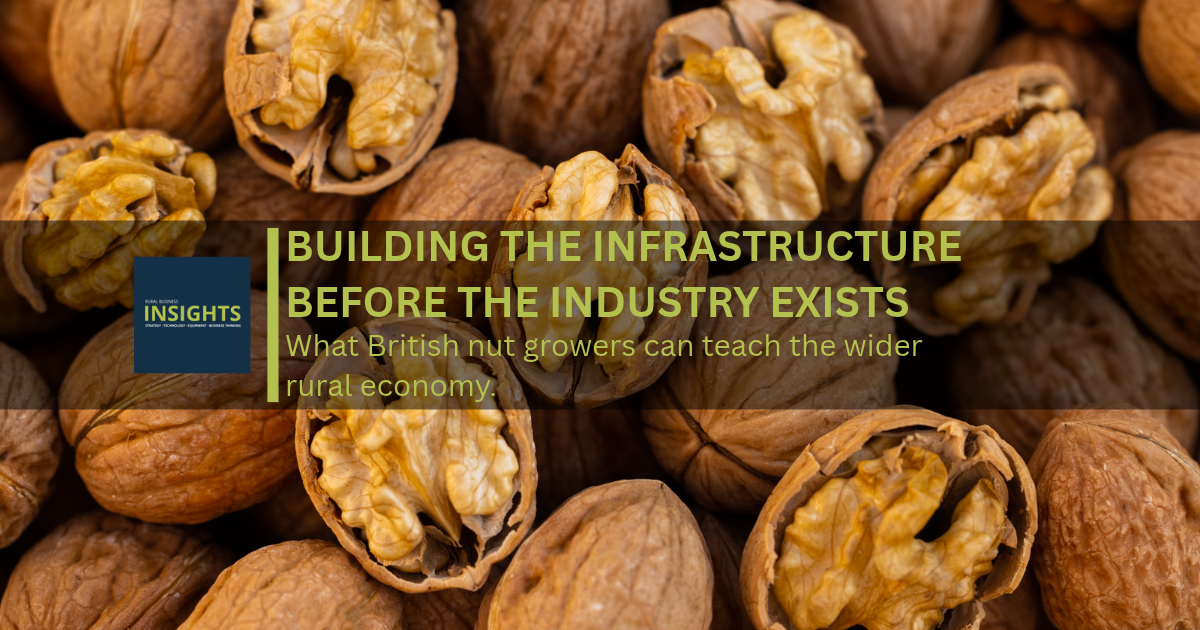
Britain already imports the nuts. The challenge is building everything else.
Walk into almost any supermarket in Britain and you will find walnuts, hazelnuts, almonds and pistachios from around the world.
What you are unlikely to find is a significant quantity that was grown in Britain.
That is not because Britain lacks a nut market.
Quite the opposite.
The UK imports almost all of the nuts it consumes, with import values reaching approximately £290.8 million in 2024, an increase of almost 20% on the previous year.
The obvious question is:
If Britain already consumes hundreds of millions of pounds' worth of nuts every year, why does a meaningful domestic industry barely exist?
The answer has surprisingly little to do with growing trees.
The Market Already Exists
Many diversification ideas fail because they attempt to create demand where none exists.
British nut production faces the opposite problem.
Demand already exists.
Consumers already buy:
- hazelnuts from Turkey;
- walnuts from the United States and Chile;
- assorted nuts from Spain, Italy and France.
The challenge is not persuading people to eat nuts.
The challenge is persuading businesses to invest in producing them.
That distinction matters.
Because it shifts the conversation away from marketing and towards economics.
A Sector Trying To Build Itself
One of the strongest signals that something interesting is happening is the emergence of organisations designed specifically to support commercial nut production.
The British Hazelnut Association was established to encourage collaboration, lower barriers to entry, share infrastructure and build sufficient scale for a commercially viable UK hazelnut sector. The organisation explicitly identifies three underlying drivers:
- volatile cereal economics;
- short-term policy uncertainty;
- rising environmental expectations.
Those are not niche horticultural concerns.
Those are strategic agricultural concerns.
The fact that growers are organising around them suggests the conversation has already moved beyond hobby orchards.
The Machinery Is Not The Story
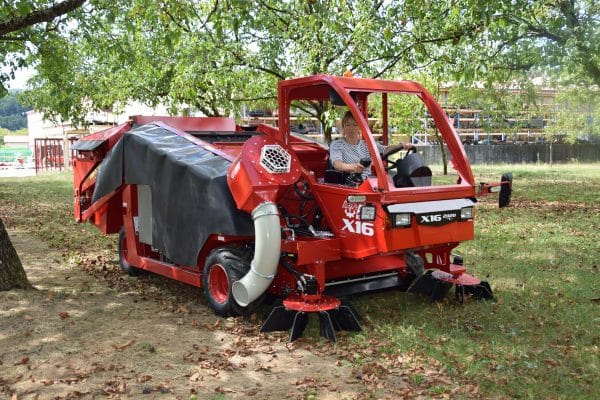
A recent demonstration of the AMB Rousset X15 nut harvester at Glastonbury Nut Farm could easily have been reported as a machinery event.
It wasn't.
The machinery simply exposed a larger question.
If nut production is ever to operate at meaningful scale in Britain, harvesting cannot depend entirely on manual labour.
Mechanisation becomes a requirement rather than a convenience.
That lesson extends far beyond nuts.
Many industries reach a point where growth depends not on producing more, but on finding ways to produce more efficiently.
The harvester matters because it removes one of the barriers preventing that growth.
The Infrastructure Gap
This is where the story becomes genuinely interesting.
Because successful agricultural industries rely on infrastructure that most consumers never see.
Milk requires creameries.
Grain requires drying and storage.
Livestock requires processing facilities.
Wine requires wineries.
Nuts require:
- cleaning;
- drying;
- grading;
- cracking;
- storage;
- packaging.
And here the emerging British nut sector encounters its biggest problem.
Those facilities are expensive.
The original industry discussions repeatedly highlight the difficulty of justifying specialist processing equipment at individual farm scale. The solution proposed by many participants is shared infrastructure and collaborative models.
This is not simply a nut-industry issue.
It is one of the oldest challenges in rural economic development.
What Nuts Can Learn From Wine
Perhaps the strongest comparison comes from another industry that once seemed equally unlikely.
English wine.
Today, the UK wine sector supports:
- more than 1,150 vineyards;
- around 280 wineries;
- over 4,800 hectares under vine;
- annual production measured in millions of bottles.
None of that appeared overnight.
The sector grew because:
- vineyards were planted;
- expertise accumulated;
- processing infrastructure developed;
- distribution improved;
- confidence increased.
A useful example sits much closer to home.
Hope Valley Vineyard, nestled beneath Stanage Edge in Derbyshire, grows grapes but works with Halfpenny Green Vineyard & Winery in Staffordshire for vinification. Rather than building a winery itself, the business accesses specialist infrastructure through partnership.
The lesson is powerful.
Not every business needs to own every stage of the value chain.
Sometimes industries grow because infrastructure can be shared.
Agroforestry Changes The Equation
The British nut story becomes even more interesting when viewed through an agroforestry lens.
Research undertaken by the Agroforestry Research Trust and others suggests nut trees offer more than a single output. Walnuts, hazelnuts and chestnuts can contribute to:
- food production;
- biodiversity;
- carbon storage;
- long-term resilience;
- diversified income streams.
This creates a question that many future agricultural sectors may need to answer:
Is the enterprise producing a crop, an environmental benefit, or both?
Increasingly, those outcomes may not be mutually exclusive.
Building Confidence Before Scale
One of the clearest lessons emerging from conversations around British nut production is that industries are built differently from businesses.
A business can often begin with:
Customer
↓
Product
↓
Revenue
An industry often begins with:
Experimentation
↓
Infrastructure
↓
Knowledge
↓
Networks
↓
Confidence
↓
Scale
The nut sector appears to be moving through exactly those stages. Growers are establishing orchards. Machinery is being tested. Knowledge is being shared. Grower networks are forming. Processing solutions are being explored.
The market exists.
The confidence is still being built.
The Bigger Lesson
Viewed through a narrow lens, this is a story about nuts.
Viewed through an RBI lens, it becomes a story about how entirely new industries emerge.
The most important challenge facing British nut production may not be choosing varieties or planting orchards.
It may be creating the conditions that make orchard planting commercially worthwhile in the first place.
Infrastructure.
Processing.
Collaboration.
Knowledge.
Confidence.
Those foundations are rarely glamorous.
They are often decisive.
Because successful industries are rarely discovered.
They are built.
And they are usually built long before they become obvious.
References
- Nuts UK Import Value 2015–2024, import values reaching approximately £290.8 million in 2024. [statista.com]
- Hazelnuts Offer New High-Value Crop Opportunity, Farmers Weekly, 1 March 2026. Discussion of UK hazelnut opportunities, imports, infrastructure requirements and commodity-market challenges. [fwi.co.uk]
- British Hazelnut Association, organisational mission and rationale, including infrastructure, collaboration and resilience objectives. [britishhaz...tion.co.uk], [britishhaz...tion.co.uk]
- Nut Harvester Demo Day, Organic Research Centre, 2026. Mechanised harvesting trials and economic viability discussions. [organicres...centre.com]
- Glastonbury Nut Farm, farm profile, orchard scale and industry-building objectives. [glastonbur...farm.co.uk]
- Agroforestry Research Trust and supporting nut-production research by Martin Crawford and collaborators. [agroforestry.co.uk], [agroforestry.ac.uk], [youtube.com]
- WineGB Industry Data and WineGB 2025 Industry Report, illustrating the development of English and Welsh viticulture infrastructure and scale. [winegb.co.uk], [winegb.co.uk]